Mistress Hibbins
Mistress Hibbins, the widow of a magistrate and the sister of Governor Bellingham, is a minor but unforgettable figure in The Scarlet Letter. She is introduced as a woman of such bitter temper that the crowd at Hester Prynne's public shaming speculates she might be a witch about to die on the gallows. Her presence throughout the novel functions as a living embodiment of the diabolical forces that Puritan orthodoxy both feared and, in a sense, created. She is the dark double of the community's piety, a figure who openly consorts with the Black Man in the forest and who sees the hidden sin that others deny. Her role is that of a sinister chorus, whispering truths that the respectable world cannot utter, and her eventual execution as a witch confirms the very superstitions she exploited.
Identity and Background
Mistress Hibbins is defined by her social position and her notorious reputation. She is the sister of Governor Bellingham, one of the most powerful men in the Massachusetts Bay Colony, and the widow of a magistrate. Despite this high standing, she is universally regarded as a witch. The narrator notes that she was "bitter-tempered" and that her "ill-omened physiognomy seemed to cast a shadow over the cheerful newness of the house." She is described as a woman of great magnificence in her dress, wearing "a high head-dress, a rich gown of velvet, and a ruff done up with the famous yellow starch," yet this finery only makes her more sinister. Her reputation is such that the crowd gives way before her, "as if it carried the plague among its gorgeous folds." She is a figure of the night, known to make excursions into the forest with the fiends and night-hags, and she is later executed for witchcraft.
Role in the Narrative: The Dark Chorus
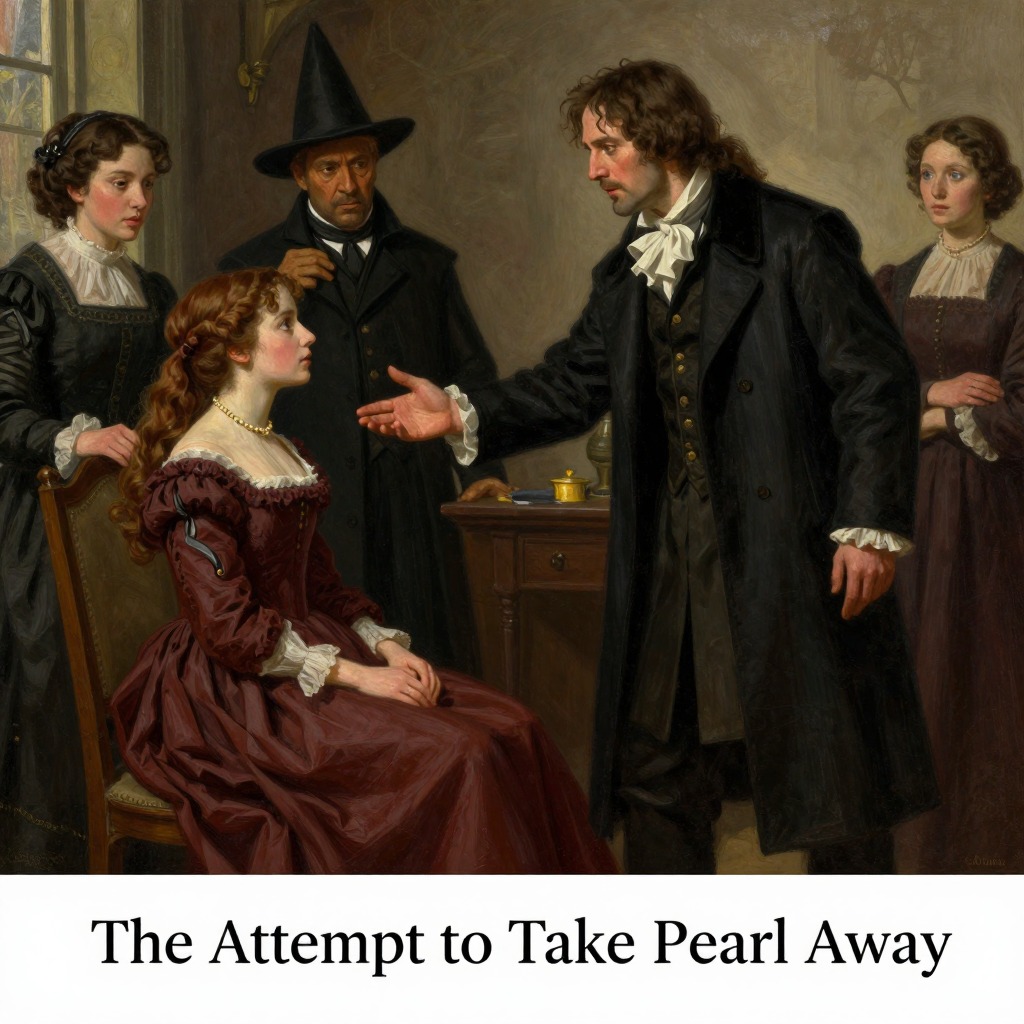
Mistress Hibbins appears at key moments to voice the hidden truths of the story. When Hester and Pearl leave Governor Bellingham's mansion after successfully pleading to keep Pearl, Mistress Hibbins thrusts her face from a lattice window and invites Hester to join her in the forest that night, saying she has "well-nigh promised the Black Man that comely Hester Prynne should make one." Hester's reply—that had they taken Pearl, she would have willingly signed her name in the Black Man's book with her own blood—shows that Mistress Hibbins speaks a language of dark possibility that Hester understands. Later, during the Election Day procession, Mistress Hibbins approaches Hester in the marketplace and whispers that she knows the minister has been in the forest, and that the Black Man has a way of making the mark of his servants visible in open daylight. She asks directly, "What is that the minister seeks to hide, with his hand always over his heart?" In this way, she articulates the very suspicion that the reader shares, serving as a vehicle for the novel's exploration of hidden guilt and public hypocrisy.
Relationship with Pearl
Mistress Hibbins has a particular affinity with Pearl, the elf-child. When Pearl asks her eagerly, "Hast thou seen it?" referring to the mark on the minister's breast, Mistress Hibbins responds with a profound reverence, calling Pearl "of the lineage of the Prince of Air" and inviting her to ride with her some night to see her father. This exchange reinforces the novel's suggestion that Pearl belongs to a realm beyond the human, a wild, pre-Christian world of spirits and demons. Mistress Hibbins recognizes in Pearl a kindred spirit, one who is also outside the bounds of Puritan society and who shares a connection to the dark, natural forces of the forest.
Thematic Significance
Mistress Hibbins represents the repressed, diabolical side of Puritan culture. She is the embodiment of the superstition and fear that the community projects onto those it cannot control. Her open consorting with the devil is a mirror image of the hidden sin of Arthur Dimmesdale, who is tormented by a guilt he cannot confess. While Dimmesdale hides his sin behind a mask of holiness, Mistress Hibbins flaunts her allegiance to evil. She is a figure of the carnivalesque, a witch who inverts the moral order and speaks truths that the pious dare not utter. Her eventual execution is a reminder of the fate that awaits those who step outside the rigid boundaries of Puritan law, but her presence throughout the novel serves to expose the hypocrisy of a society that punishes open sin while harboring secret guilt. She is, in the end, a more honest figure than the minister who preaches virtue while hiding a scarlet letter on his own breast.